The Girl with a Dog and a Blog

Inspiration for blog posts is entirely unpredictable.  Sometimes I find myself making lists of ideas.  Some times I find myself scrolling those lists with the same feeling as when I’m eyeing the numerous items hanging in my closet and thinking, I don’t have anything to wear!

And even when I have an idea, it’s kind of like riding a bull.  You can lead it anywhere it wants to go.  You never know exactly where it will take you or even if it will buck you off before the end.  It looks easy, but it’s just not.  The fact that you did it before doesn’t mean you can do it again.

So for these and lots of other reasons, I don’t consider myself an official “blogger” although a few people have surprised me–not long ago I was introduced to a group as the girl with a dog and a blog.  Ha!

Blogging has taught me some about what people think about me; usually in the form of tiny bits of feedback.  One friend I’ve known for years even read my blog and said, “Danielle, I didn’t know you were that…deep.”  Hopefully, they were not referring to the taco meat incident.

But my goal here is actually not about me, but wanting to give credit to the three people who inspired me most to start blogging (again).  My dad, who has always wanted me to write; Matt Walsh, whose creativity can make truth that you’ve heard a thousand times still fun to read; and my friend Colleen, whose blog often spoke to me in ways that were exactly what I needed–convicting my hard heart or gluing together broken pieces of my soul.

My dad probably deserves the most credit; I’ve already blogged about him.

Matt Walsh, I’m told, has the best read blog on WordPress, so he doesn’t need my introduction.  While I don’t always agree with him, he has a gift for getting his point across.  Like this one.  And regardless, I’m glad that there are young conservative bloggers out willing to speak out with unapologetic common sense.

That leaves Colleen–we both grew up in the same homeschool circles in Southern California.  She was five years older than me, so I wouldn’t say we were close friends, but I always had a lot of respect for her and knew 1) that she loved the Lord with all her heart; and 2) that she was a lot of fun.

Colleen was gifted in a lot of ways–singing, drama, working with kids, speaking, and writing to name a few.  Everyone wanted to be her friend and so she was forever being stretched in numerous directions, perhaps at the expense of basic necessities like sleep.

Colleen & Eddie Chao

But despite her gifts, her beauty, and her attractive personality, when God wove her story, He didn’t choose to write marriage into the picture until she was 34–a number that used to seem very old to me.  I had long since moved from California by then, but I was able to catch glimpses of her life through things like Facebook and I read her blog with interest.  (Not dreaming then that I would identify so strongly with some of the challenges that she had faced.)

Her long-awaited dream of motherhood came at age 35 but it has been followed by a severe string of health problems, again altering her story from what she would perhaps have written with her own pen.

But anyone who knows Colleen would not make the mistake of thinking that she is not deep.  Colleen is deep.  And so is her faith.  For as long as I’ve known her, she has shared honestly about the insights that she received from Scripture.  Insights that have come from hours of reading, studying, meditating, and then singing, praying, or composing back to God.

The faith she has clung to in the midst of her numerous health challenges is evident in posts such as  We know Him Best.  And her eloquence is apparent, when, as a new mom she penned posts such as The Weak and the Warrior.  Colleen’s depth is accentuated by the time she will take to condense and organize her thoughts into a short, powerful prose that gives us a window into a quiet but fruitful life.

Although I was often encouraged by her blog, I didn’t write much myself for years–partly because of time constraints, but often because of my fears.  I hate putting personal information on the internet for the world to read.  I fear the combination of evil men and modern technology–call me crazy–but when I look down the road, I see a lot of potential for us to regret we are so free with personal information.

But in the end, I decided it was better to be fruitful than to be safe.  I would rather be a threat to evil and to myself than a threat to nothing at all.  I would rather get to an untimely end with nothing left to give, than live a long life and have buried any little talent entrusted to me.  If there is a chance I can write and encourage someone–anyone–to love God more, I’m going to try.

And if you’ve been even a bit challenged or encouraged, you can say thanks to my dad, Colleen, and maybe even a little bit to the courage of Matt Walsh and the day he wrote the controversial piece, Monogamy is Unnatural.

Joy Bells

As a teenager, my dad took us to a small church across town on Sunday evenings. When I say small, that is what I mean. There would be about a dozen people, and seven were my family. The rest were over the age of seventy.

They were sweet people and they loved to have us join their Sunday evening routine. We would open our hymn books and the pastor would take favorites. My sister would accompany on the piano as we picked the same handful of songs. Despite the age of the group, it was not unusual for us to sing “Arky, Arky” and strain our voices to reach the high notes of “Wonderful Grace of Jesus.”

After we were sung out, Pastor Dana would preach to us and then the “whole church” would go to Denny’s.

I remember all the members of that small congregation. Best of all, I remember the pastor’s wife, Louise Dana.

I first met Mrs. Dana when I was in kindergarten and I had liked her then.

She always dressed smartly. Her two inch pumps would match her dress and her chunky earrings would match her necklace. She was pleasantly plump—she didn’t bother with any diet that came between her and a banana split. And she had an amazing laugh. She laughed loud and she laughed often. Wherever she was would be a party.

When we started attending some ten years later, Mrs. Dana had not changed a bit and probably neither had the evening routine. Mrs. Dana knew the staff at Denny’s by name and they knew her. We would talk and laugh and she would eat a banana split.

Then came the news that Mrs. Dana had Lou Gehrig’s disease. I didn’t quite believe it–she was so full of life and I just couldn’t imagine her anything but her boisterous self. But she seemed to handle the news well. She would be there every Sunday evening happy.

The effects of the disease came on gradually. Her speech became a little slurred and she became less mobile. We never talked about it at church. Everyone knew; we just didn’t know what to say. Things stayed at their “normal” routine, “Wonderful Grace of Jesus” and all.

Her speech continued to get more slurred although she tried hard to communicate. When we couldn’t understand, we’d nod and smile. The evening outing to Denny’s just wasn’t the same though when the boisterous storytelling was replaced by a few laborious phrases. Her mind was still sharp, but everything she wanted to say and every laugh she wanted to laugh was trapped inside and it couldn’t get out.

Then one week we got a new hymn request— “Joy Bells.” And she requested it every week after that. It started, “You may have the joy bells ringing in your heart and the peace that from you never will depart…”

Mrs. Dana couldn’t sing, but she started bringing a bell to church on Sunday nights and she would ring it every time we said “joy bells” and at the end of every line of the chorus. It was her way of letting us know that even though she could no longer laugh, she still had joy in her heart.

One bell was not enough. She brought two…then three…then four…and each week she would ring her bell to make her request and make us ring the bells as we sang. Honestly, it wasn’t very musical. But from Mrs. Dana it was joyful.

Time continued to waste away and so did Mrs. Dana. She had her husband bring Krispy Kreme donuts to church because it was all she could eat and she wanted to share them. Even on a Krispy Kreme diet, she was now less than 90 pounds. She would sit silently in the pew and when we said hello to her, she would do her best to give a slight nod. But when we sang her song, she would ring her bell. That was all she had left.

When I rang my joy bell, it was neither musical nor joyful. I would be too choked up to sing. I felt strongly for this dear woman whose body could no longer communicate in the ways she loved best.

Or maybe it did. I doubt any of us who knew Mrs. Dana will ever forget the joy that was her strength in the most difficult of circumstances. She expressed it in a means and with a fervency that none of us will ever forget.

That was probably 16 years ago, and I haven’t sung “Joy bells” since her funeral. But I’ve thought of it many times—always with the collection of souvenir handbells ringing in the background. And I know that in heaven, Mrs. Dana is talking and laughing again. And on earth, her memory is reminding us that despite our circumstances, we’ve been instructed to “rejoice always.” Even when you cannot talk and cannot laugh—no excuses. Find yourself a bell and let the world know that you are joyful—even when it is through tears.

Pops Goes the Fourth!

bostonWe were fairly new to New England. One of the guys in our church college and career group (who defied all of the rules of single adult living and was actually a planner) had the idea of going to hear the Boston Symphony Orchestra live under the hat shell in downtown Boston on the Fourth. Then, of course, to climax the evening, there would be a spectacular fireworks show.

Boston on the Fourth. What could be more patriotic than that?

So while Planner put together all of the important details, college and career groups can turn even the smallest of details into cumbersome and tiring Group Decisions. A characteristic of C&C groups that has caused more people to starve to death than the potato famine. I hate Group Decisions.

In this particular instance, the group of us stood in the parking lot all of 15 minutes trying to decide who would ride in which vehicle. We had one Lady Driver and one Man Driver and there were one too many girls to fit into Lady Drivers’ car. Hence the dilemma.

One girl attempted to solve the problem and volunteered to ride with the guys. Man Driver actually resolved the problem by replying that it would probably be better if one of the “skinny girls” rode in his truck instead. Mind you, we were all on the thinner side except Volunteer.

To say her feelings were hurt would be putting it mildly. Not a great start to the day.

But, as I hinted, he did resolve the issue because we girls suddenly realized that we could all fit nicely in the girl car and we would just see the guys at the sub station. Decision made.

The first stop of the day had been carefully plotted thanks to Planner and we went to the hat shell to stake a claim on the grass with a blanket and pick up wristbands which would later grant us admission to the Pops Goes the Fourth! concert.

It was 7:00 am. It was 700 degrees. It was 700% humidity.

After that we were “free to sightsee” a phrase which herein means “free to debate what to sightsee.” Planner was actually pretty familiar with the city, but he was completely overshadowed by the two strong personalities held by Lady Driver and Man Driver–neither of whom knew the area. And when I say, strong personalities, I mean with a capital “S.” In comparison, I am meek as Moses (and a lot less likely to hit rocks).

Lady Driver trusted no one with the planning of our Independence Day in Boston. She was determined that the first order of business was to procure a map. This was, of course, before Google maps and smart phones. But even then, printed maps didn’t exactly fall out of parking meters.

By the time we found a map, frankly, it wasn’t necessary. We knew downtown Boston by heart. And Lady Driver had blisters. So now we all needed to go on a band aid hunt.

Mind you, there were still other strong personalities expressing other opinions about what to do, but Lady Driver pretty much had her mind made up. Regrettably, Man Driver was still being punished for his unfortunate comment in the parking lot. And since the girls followed Lady Driver and since there were more girls, when we took off, the guys eventually followed. Hence…decision making morphed from “Group” into a dictatorship/democracy with female only suffrage.

It was probably a little before noon before we settled on our first real attraction of the day–the Aquarium. The Boston Aquarium may be best known for its penguin exhibit, but frankly, all we cared about was the A/C.

It was a long, long day but somehow we made it to 7:00 pm and the esplanade in front of the hat shell. Keith Lockhart was directing the Boston Pops with Barry Manilow as a special guest. I didn’t know who Barry Manilow was, but the lady next to us sure did. She looked at him with sunbeams in her eyes and sang every word of every song along with him–hands clasped in front of her and the whole bit. Her husband just sat next to her and scowled.

It was a good concert though–they played all the classic John Phillip Sousa marches and it gradually cooled off to about 600 degrees and for the first time that day, we seemed to be able to relax a little and actually enjoy ourselves.

The fireworks were good enough to make Walt Disney jealous. And by the time they were in full gear, we were starting to think Planner had actually had a good idea. So, when he suggested that we leave where we were and head to an area to the left of the esplanade, we trusted his judgment.

But this one time, Planner made a mistake.

In theory, we were going to be able to see some of the smaller displays over the water better from the new vantage point, but in fact, we could see nothing. The space was crowded beyond belief but by the time we had fought our way in through the crowds, there was really no getting out.

The fireworks ended and when we turned our attention to a way out of the crowds, we realized that we were stuck on a tiny island with about ten thousand other people and one foot bridge. At first, I thought we were making headway, but soon began to realize that the only thing that was happening was that we were becoming more compact. Very compact.

It’s an unpleasant feeling when the sweat streaming down your back is not your sweat. When a fly lands on your head and you can’t free a hand to swat at it. We were so compact that I was in one row, my feet were in the row behind me, and my purse was about three or four rows behind that. It would have been the perfect opportunity for someone to wipe it clean. If they could have gotten their hands free.

I don’t know how long we stood like that, but it was at least two hours because by the time we got off the island and to the closest subway, it was after midnight and the sub was closed. As was the next. The next. And the next.

So it was actually well into July 5th before we found ourselves truly heading for home. We were all in need of band aids, and frankly, by that point, any car would do.

Needless to say, the logistics of that day sort of eclipsed the whole patriotic celebration thing and it’s taken 12 years for the sweat to dry so I could really laugh about the experience. But when I count my blessings and give thanks for the freedoms that so many have given so much for—I count among them the freedom not to go to Boston on the Fourth.

Two Become One

My hairstylist tells me that there are 2,500 weddings a year in Charleston. I’m sure the month of June claims a disproportionate share of that number…My parents were married in June. All three of my sisters we married in June. It’s just the month for weddings. School’s out…Spring’s hanging on… Love is in the air.

And no where do I sense the love more strongly than during my frequent trips to Penney Farms, Florida.   That’s where my grandparents live. They are now 95 and 98 and their lives have been simplified accordingly. They live in a two-room apartment. Their kitchen is the size of my closet and boasts only a hot plate, a microwave, a refrigerator and a small sink.

Their bed swallows the bedroom, leaving room for an 8” TV. Grandpa will pull his wheelchair next to my Grandma and they will watch the Andy Griffith show. And when Andy isn’t “sherriffing,” they will watch the goings’ on around their retirement community on closed circuit TV.

My grandparents weren’t married until they were in their 30s. But that still leaves a lot of time—65 years.

They are both from the Philadelphia area, but met at Wheaton College. Grandma—Frances she would have been called then—was a student there. And George, my Grandpa, met her when he came to pick up his sister one weekend.

It wasn’t really the beginning of anything although Frances was later invited so spend some holiday time with his family. And when she stayed for a few summer classes after her last year, George was there too and she remembers some long evening walks in the cornfield affecting her grades.

But they didn’t stay in close contact and when she went to Florida to teach at a Christian boarding school, he went to seminary in Texas, and later, to the South Pacific on an aircraft carrier.

I haven’t heard too much about the seven years Frances spent teaching except that Elizabeth Elliott was one of her students. And that she loved it.

As World War II came to a close, George wrote to Frances and asked her to marry him. She wrote back and said yes. That’s how it was told to me, anyway.

When the school found she was leaving, an angry headmaster had her pack her trunk and dumped her off at the train station during a chapel service. She had nothing. She got to say goodbye to no one. Seven years of investing in students ended abruptly, and suddenly, she was alone in the world with one trunk and a fiancé that she had hardly seen in years.

“But,” she told me, “perhaps it was for the best. Because I never looked back. The next few years were not easy. But I never looked back.”

Six babies came in rapid succession, starting with my aunt, Christine, less than a year after their wedding.   George and Frances were practically living in their car while doing deputation around the country but by the time my mom was born, they were trying to plant a church in the war-torn country of Japan. Of course, between those two was a three month boat ride—the only means of transportation between here and there.

They started from scratch in Japan. They didn’t speak the language. They didn’t know the culture. They didn’t have a way to communicate back to friends and family. They didn’t have a lot of money. But they had each other. And they put their whole hearts into their new life in Japan.

After about 35 years, my grandparents retired from the mission field and took jobs in Florida. They used to travel to California to see us for one week every summer. Grandpa would take us on bike rides, buy us ice cream, and let us blow on his trumpet. I remember sitting on his lap while he read “101 Dalmatians” to my sister and I.

Meanwhile, my grandma would take over the laundry and for a week nothing could hit the bottom of a hamper before it would be snatched out; and nothing came back to you without starch in it.

They were both hard working, frugal, and godly. That isn’t to say they always agreed. Grandma would try to discourage my grandpa from buying so much ice cream, for example. Nonetheless, they complimented each other well. Grandma was good with the check book, but she didn’t operate anything with a motor it. Grandpa not only could operate a vehicle, but he was adventurous.

They could eat at Wendy’s for $2. They would order one baked potato and a cup of coffee. Grandpa liked sugar in his coffee and Grandma did not, so they would put one pack of sugar in, but not stir it. Grandpa would put his straw on the top; Grandma would put hers on the bottom, and everyone was happy.

They seemed timeless to me.

But old age creeps up even on the most stalwart of people. I took my grandparents on their last plane ride out of Florida last year—Pushing Grandpa in a wheelchair and waiting on a skycap to come get Grandma. I remember waiting at the gate in Atlanta for a flight and getting hungry. Grandpa, who is always hungry, agreed to go with me to find food. Grandma, who is never hungry, preferred to stay at the gate. “Don’t get me anything.” She called after us.

As we placed our orders, Grandpa was quick to ask me, “What are we going to get Grandma?” I opened my mouth to remind him that she didn’t want anything, but shut it again. I repeated this. “What do you think she would like?” I finally asked. And when we headed back to the gate, we were carrying three Styrofoam boxes.

He did the same thing a couple of weeks ago when my grandma wasn’t feeling well. Although the doctor couldn’t really find anything wrong, she had been in bed the better part of the week, and Grandpa was as frantic as I’ve seen him. At this stage in the game—they heavily rely on each other. She has the legs to get up and find things, he has the arms strong enough to dish the ice cream. She has good enough ears to hear the TV, and his eyes are still able to see well enough to read her magazine articles, her Sunday School lesson, or whatever else.

When she was sick, he was rattled. It wasn’t just like having a sick family member. It was like part of him was sick too. I could tell he wanted to “fix it,” but he couldn’t. So when she insisted that we go to the dining hall without her, he agreed only when he knew there was no changing her mind.

She said she wasn’t hungry, but he picked the entrée and sides that he knew she would like best. He ate half of each, dutifully saving the rest and carefully arranging it in a “to go” box. He didn’t say so, but I think he knew that she wouldn’t eat it, but she would know he cared.

He did care. He does care. In fact, I suspect he is holding on to life because of her. Because if something happened to him, who would dish the ice cream? who would read the Sunday School lesson? who would operate the golf cart?

Conversely, she is holding on for him. She is still trying to find things—even though her eyes are bad—because he can’t seem to find them without her help. She is still trying to move money from one account to another to get a little better interest rate. Still picking his laundry out of the hamper and making sure it comes back to him with starch in it. Still washing his ice cream dishes. Still discouraging him from buying ice cream.

They’ve never owned a home, yet they’ve built a beautiful family. They’ve never been famous, but they have touched many, many lives. They’ve never written a book, yet theirs is a beautiful love story. And as of yet, it’s still not all told.

Of the 60 weddings this weekend in Charleston, I wonder if even one of them will stick together enough to know the kind of simple, faithful love my grandparents know.

I’ll always remember the image of my 98 year old grandfather, after 65 years of marriage, saving half his dinner in a “to go” box. Because half of him was still at home. The half that he loves most.

Wading in to the Modesty Debate

You’ve probably seen them. There are two of them—two complementing billboards on I-26. Big as life.

One of them shows a beautiful girl in a tight tank top and a pose that looks very much like an invitation and these words: It’s an outfit, not an invitation.

The second one says The little black dress does not mean ‘yes’ and it shows a pair of long, sleek legs parading out from beneath a very little black dress that practically screams “yes!”

I don’t understand these billboards. Why not put one up that says, Gravity ends Friday! or Eat cake to Lose Weight!

I’ll tell you why not.

The why not is because it would be a foolish waste of money. Putting a lie on a billboard does not make it the truth. There are certain natural laws that a billboard just can’t change. Not two. Not two thousand. Not two million.

I wrote these billboards off as some government grant that was procured by a marketing firm…or maybe by some teenage trust baby playing a practical joke. But billboards are expensive—especially on I-26—so I confess, every time I drove by I found myself asking that question. Who thinks this nonsense up? Planned Parenthood?

But I’ll admit, I’ve had some surprises in the modesty department lately. One was an article by a girl purporting to be a Christian who claimed that the Bible does not teach modesty. For someone who didn’t really know the Bible and just wanted to believe her, it would have been downright convincing.

The other big surprise was after reading an article heavily circulated on Facebook yesterday. It was a fairly good article on modesty, no real surprises there, what surprised me were the comments at the bottom. From my quick scan, it appeared that 2-1 the comments were attacking the author and attempting to “debunk” the case for modesty. It was a cesspool of stupidity really, and if I wasn’t so shocked, I probably wouldn’t have kept skimming. There was a little of everything—husbands, fathers, wives, daughters, old, young, Christian, LDS—all kinds.

The negative attacks boiled down to three arguments: 1) clothes are irrelevant to modesty; 2) women are only responsible for themselves—not some man’s wrong thoughts or deeds; and 3) you should judge someone by their character and not by their physical appearance.

Now, I’m no logic professor, but I think I could make a pretty good case that the first argument is equivocation; the second is a straw man; and the third is non sequitur (which is a sophisticated what of saying, just plain dumb).

The first idea—that clothes are irrelevant to modesty and the notion that “modesty is on the inside” is really not an argument, it’s a distraction. Looking to the authoritative source known as Wikipedia, “Modesty is a mode of dress and deportment intended to avoid encouraging sexual attraction in others; actual standards vary widely.”

That is what we’re talking about. If you want to talk about something else, save it for another day. 

Of course, clothes that cover are not the only ingredient of modesty, but they are kind of like the chocolate chips in the chocolate chip cookie.  Without them, it’s not modesty.

The second passionately made argument was a straw man because the author never said that anyone was responsible for anyone else’s wrong thoughts or actions. But what if she had? If you want to know what the Bible says—it has strong words for someone who causes someone else to stumble. Something about a millstone, a rope, and the ocean. The fact is, we aren’t judged for what other people think or do. We are judged for what we think or do.

Just let that sink in.

Even if you don’t care what the Bible says, you have to agree with me. If you give your eight-year-old a stick of dynamite and they blow up an elementary school, you should be held responsible. Even if you told them not to light it.  Okay, so that’s an extreme example—I’ll give you that—but why do we have crimes like “Contributing to the delinquency of a minor,” “accessory after the fact,” or “accomplice”? You can be only a fraction of the problem and still have done wrong.

The point is that if what you do makes it more likely that someone else will do wrong, think long and hard about whether it is right.

And as to the third argument—that a person should be judged for themselves and not for their clothes—it’s really not worth the ink. But some people actually believe that, so I’m going to address it anyway.

I guess the argument would go something like this:

Women should be treated with respect;
Certain clothes tend to cause men to respect women less;
Therefore—clothes are irrelevant.

See what I mean about non sequitur?

Because the fact is, that modesty is a virtue, virtues are what make up your character—or lack thereof. When you get dressed, you are telling the world about yourself—I’m cheap, I’m expensive. I’m neat, I’m a slob. I’m trendy, I’m classy. I want to be comfortable. I want to be noticed. I don’t give a rip. I shop at Goodwill. I shop at American Eagle. I want a job. I have a job. I’m a Carolina fan. I like black.  I’m insecure.

That’s not to say you can’t use clothes to hide the truth about yourself, but why would you try? Because you know the clothes are making a statement. You are hoping that the statement the clothes are making drowns out something else about you.

Frankly, no one’s character is judged independently of their physical appearance. However, for some of us, our clothing will say, “my character is important” and for others, “my character is not important.” But either way, our clothes, like our actions, speak louder than our words.

You can’t fight that. You will get the kind of attention you dress to attract; even Clint and Stacy preach that.

This would be the place for me to make the case for modesty. But actually, I’m not going to try. I don’t think I have a platform on this topic; I don’t hold myself out as any kind of role model.

I will just say this to Christians: don’t buy the lies the world is selling.  And don’t present yourself with the false dilemma that says that if I want to be modest, I’d have to dress like a “prude.”  Be honest to yourself about why you are wearing what you wear. If you seek godliness, don’t make excuses. Don’t interpret Scripture to conveniently suit your desires. Don’t let society dictate your standards.

Own it.  You give the invitations your clothes give. You say “yes” when your little black dress says “yes.”

Deep down, we all know that.

Driving School

The room was full of 15 year old kids. All the girls were wearing the exact same style of short gym shorts. Most of them had their hair up in a messy bun, but a few had it hanging down in their face where they could flip it over their shoulder every so often.

By contrast—I was wearing—actually, I don’t really remember what I was wearing. It didn’t matter. It was a Saturday. I was across town serving a sentence.   It wasn’t as if I was trying to impress the row of boys trying to get their driver’s licenses.

He started by having them go around the room and state their name and what school they are from. “Wando” teen after teen said, naming the local public school.

Then he got to the two whispering, gum cracking girls in the middle. “B-E” They both said.

I figured out B-E stood for Bishop England—a nearby catholic school where the tuition is so astronomical that you pretty much have to be astronaut smart to make it worthwhile. They did not come across as astronaut smart. But here I am, judging.

“I went to B-E.” The 50-something teacher said.   “That was back when it was taught by nuns. They used to whack us with rulers if we didn’t behave.”

The wanna be astronauts did not look impressed. They have probably never been whacked with rulers. But here I am, judging again.

“It isn’t so bad…” one girl admitted. “If it wasn’t for the uniforms. And all the rules.” She said with emphasis.

They are not going to be astronauts.

Then he got to me. Instead of stating my school, he had me state my crime. I guess the fact I was not in short gym shorts gave away the fact that I was twice the age of this room full of fresh, new accidents waiting to happen.

I got a ticket for going 67 in a 55.

My first ticket. Ever.

In Wise County, Virginia.

Where they give out tickets like participation ribbons.

And hate passers by.

And don’t care about tourism.

Or the economy.

Or my insurance premiums.

Or my feelings.

Or my bad day.

Of course, I didn’t say all that, just my name and my crime.

For 16 years I could have been the poster child for the ACE driving course. But that all ended in one bad day when I became a victim of the Virginia conspiracy. And here I was—having shelled out attorney’s fees, court fees, driving school fees—spending 8 hours on a sacred Saturday listening to a man who was bitter about being hit by a ruler 40 years ago.

And the teens were looking at me with faces that said—I will never be the old person sitting in the back of the room stating my name and my crime to a room full of cool teenagers.

Okay, well then, my advice to you, O wise ones, is this: stay out of Wise County, Virginia.

A college girl sitting next to me similarly had to confess: believe it or not, she also got her first ticket driving through Wise County, Virginia. Were you listening, astronauts? This is proving to be the most important thing you’ll hear all day.

He handed us each a booklet full of blanks to fill in and started up a power presentation. Vaguely, in the back of my mind, there were faint memories forming. My first few times behind the wheel. A few more gray hairs on my dad’s head.

I remember one driving moment well—

Dad: Danielle, slow down.

Me: But Dad, the speed limit is 45.

Dad: Danielle, the driver in front of you is going 35.

He had a point. Too bad he didn’t also tell me to stay out of Virginia.

It was one of the longest days of my life. I decided that before the lunch break. I decided that before 10:00 am. There is nothing like being in a room full of 15 year olds to make you feel like you need to stop on the way home and get measured for dentures.

When a question starts with “Like, okay…well…like, I mean, like…okay…” You just know it isn’t going to be a question that you need to hear the answer to.  I felt sorry for the teacher who, after this exciting day, was going to be doing behind the wheel with these teens. I might rather be hit with a ruler by nuns.

He tried to get their e-mail addresses and some of them looked at him with those looks that say… “What? Do you think this is like 2005 or something?”

I tried to stay awake. I really did. The teacher methodically plodded through the material. How to change lanes. When to change lanes.

Then he started talking about drinking and driving. I suspect that sometimes the old people in the back of the room are serving a more serious sentence than I. I thought perhaps it was for my benefit or the college girl next to me.

But apparently not.

“I know you guys are going to drink.” Mind you, he was a retired cop. “I know you’re going to party. I know you’re going to do what kids do.”

And then he started on the whole “don’t drink and drive: it might kill you” scare.

I was really sad. I was sad because he told those kids that he expected them to break the law. He expected them to get drunk. He expected them to spend their teen years doing stupid, foolish, and even illegal things. Other kids did, so these kids would too. He was just hoping that they would avoid dying in the process. And it would be good if, in addition to not killing themselves, they avoided killing other responsible drivers.

That was his advice to them.

I could hardly keep my mouth shut. I wanted to get up and preach. Don’t set your bar so low. Don’t make it your boundary not to get in a car so drunk that you won’t make it home alive. Don’t treat the law like it is subject to a popularity contest.

Do the right thing. Being a teenager doesn’t give you a pass. Being a teenager doesn’t free you of other consequences of sin. Believe it or not, dying in a car wreck isn’t the only potential hazard of alcohol. And alcohol isn’t really the issue. The issue is the mindset that you can do whatever you want…So we have to try to convince you that you don’t want to drink and drive or undertake other harmful behaviors.

Why can’t we ask teenagers to do right because it right? Why can’t we set the standard a little higher than “don’t kill yourself and others?” Regardless of the dangers, regardless of the consequences, regardless of what everyone else is doing, do the right thing. That’s why God created the concept of authority, so you would know what the right thing is. When you reach a place in life when you wish people would tell you what to do and what not to do, then you are probably mature enough to start making your own decisions.

And for Pete’s sake, if you are the authority, tell a kid to do right.

When the officer pulled me over, he didn’t care that I was driving with the flow of traffic. He held me to the standard of the law. Admittedly, I didn’t like that. But that’s life and teenagers need to understand that just as well as adults. Anything less is chaos.

I suppose the teacher that day meant well. He was probably just afraid of sounding like a crabby nun waiving a ruler. He wanted the teens to feel like he understood them. So he encouraged them toward foolish behavior—as long as they stopped short of wrapping their new cars around the Charleston oak trees.

And I suppose, if I had been given the opportunity to rant from the back of the room, they would have regarded me like a crabby nun waiving a ruler. But I cared about them. Not just that they stayed alive, but that they did right.

So there you have it. I’m preaching to myself again: Do the right thing. Doing right will avoid all the consequences of doing wrong—not only the most severe—and it brings its own rewards.

And in case you make a mistake, stay out of Wise County, Virginia.

Okay Grads, Here’s My Advice:

thEXP33LMKIf you’ve perused the card aisle recently, I’d bet my teeth that this is the jist of what you read in the graduation section. And if you are like me, this is what you thought.

Follow your dreams. After all, It worked for My Little Pony, the Little Mermaid, and Rainbow Brite.

Believe in yourself. Because there are a few worse things you could believe in—like zombies, My Little Pony, and Rainbow Brite.

Reach for the sky. There’s nothing up there. But it will be a good stretch.

Be yourself. Don’t let anyone change you. Just be yourself at a big school on the other side of the state so I don’t have to put up with your selfish attitudes.

Enjoy the journey. And if you get a job, you might have enough money to travel, too.

Look inside yourself; then follow your heart. Wow. And they say texting and driving is dangerous!

What you believe, you can achieve. Yeah, I guess CNN still doesn’t believe in finding Flight 370.

What matters in life is not your success, but your significance. And you’ll never be able to accurately measure either one. That’s depressing.

YOU did it! That’s right…YOU opened your eyes every morning when the alarm your parents bought you went off. Then YOU put on the clothes your dad paid for, ate the breakfast your mom made, and one of them dropped YOU off at school carrying the lunch your mom packed. YOU stayed alive all day while your teachers tried to beat knowledge into your head against your will, and then YOU sat and griped at the kitchen table while your mom made you do your home work. And when it was all over, your parents made you go to bed so YOU would get enough rest to do it all again the next day. For a lot of years.

And now I’m writing YOU a check.

Needless to say, I am unimpressed with graduation cards.

So I googled the best graduation speeches. I read speeches given by everyone from Steve Jobs to Steven Colbert. And each of them were basically the same thing as reading the wall of cards at the grocery store. You did it! Now follow your dreams. You haven’t failed until you stopped trying. I don’t think there have been more commonly repeated lies (with maybe the exception of that little thing about how you could keep your insurance).

To be fair, there were a few statements here and there about hard work and giving back. But almost every speaker seemed to be trying to inspire graduates to ______________? I’m not sure. Be themselves??? Keep moving forward???   Think??? Why, at graduation, do we all feel so compelled to inspire and yet resort to such ridiculous statements like this card.

Now don’t get me wrong. I’m all for celebrating milestones. And I think there is hard work involved in school—especially some school—that is worth rewarding. But it truly amazes me how many words a speaker can string together and say nothing. On graduation day, that seems to be completely acceptable. Even for non-politicians.

But what most graduates need is not as much recognition of their achievement, but preparation for change. When a graduation is followed by a major life changes—different location, different friends, different activities, different schedule, and student loan payments–all at once, it is little wonder that so many grads struggle. Good thing we’ve equipped them with helpful phrases such as: Like shining stars, every one of us has the potential to light up the darkness with our own particular brilliance.  [Author unknown.  I didn’t write that gem.]

I feel compelled to do better than that. And since no one asked me to speak at a graduation and since I can’t find any good cards, here is my advice:

Practically: Get a job. Any job.  Forget all this nonsense about doing what you love.  The fact is, you won’t love any job every day.  You will love a job most if you are good at it.  And you will get good at it by doing.  So yes, get a job you think you’ll like if you can.  And if you can’t, just get a job.

Work hard. Try to make your employer successful. Don’t be above any task. Learn everything you can learn—in your mind, don’t think of it as flipping hamburgers, think of it as learning how to run a business. You can build valuable skills just about anywhere.

Be kind to your co-workers. You will enjoy your job more and you will learn how important people skills are to anything you do. If your co-workers are obnoxious, weed-smoking, partiers, then take note of the fact that they work at a hamburger joint and for Pete’s sake, don’t try to be like them. Work that much harder so you can get out of there faster. Take the good and leave the bad, but be kind in the process.

Respect your boss. He knows more than you do. True story. Sure, he may not appreciate you for everything you are and do. He may not know all the hoops you had to jump through to carry out his instructions. He may not keep you informed of everything that you really should have been told. But that’s life. And one day, when you’re the boss, you’ll forgive him everything.

Emotionally: Be grateful.

If you want to be happy, be grateful. Gratitude can lift your spirits like a hot air balloon and an ungrateful heart will sink you right into the electrical wires. Remember how little of your achievements are really that—your achievements. Thank the people who have invested in you.

Spiritually: Seek first the kingdom of God and His righteousness. All the other things will be added to you. (Matthew 6:33)

So there’s my advice for graduates.  And here is my free bonus advice: don’t get a tattoo.

And here’s my advice for non-graduates: Don’t waste your money on a card. Just write your check for $4.00 more and give it to them with a firm handshake. If they feel cheated, they can always go to the grocery store and buy themselves a card.

But I’ll bet my teeth that they won’t.

photoShe had a temper growing up.  Of course, so did I.

The difference is, people who knew us then will believe it about me.  My sister was like a living Elsie Dinsmore—sweet, sensitive, and obedient.

I was more outspoken and more type-A, so I was often the ring leader even though she was two years older.  I was also a merciless competitor.  We ended up in the same grade homeschooling, and in my immaturity, I made it a point to finish first and be the best at everything.  The only game I couldn’t beat her at was Monopoly.  She could pinch a penny.

For a while, we shared a room.  Mom used to say of us that we were “enemies all day and friends all night.”  I don’t remember what we stayed up late chatting about, but I do remember some of our fights.  I thought she was messy; she kept entirely too much junk.  I also rebelled when she came up the idea of washing our clothes in the bathtub instead of sending them downstairs to the laundry.  Allyson was more than a tad obsessed with anything old fashioned, and the idea of washing clothes by hand appealed to the pioneer homemaker in her.   I was a lot happier limiting old fashioned ways to my imagination.

Allyson was blessed with a very keen sensitivity toward sin.  What was right was right and what was wrong was wrong.  If something was right, you did it.  And if it was wrong you didn’t.  For several years, she determined to carry her Bible with her everywhere she went.  And when she was twelve or so, she decided to wear only skirts or dresses; a resolve she has kept to this day.

Despite our differences, we called ourselves best friends.  Looking back, that was her idea, and she was a loyal best friend.  I kind of drifted a bit, especially when people started of thinking of her as “different”—carrying around her Bible and wearing skirts all of the time.

She was one of the most disciplined teenagers I’ve known.  She would get up at 5:00 am to do aerobics (to classical music).  By then, I shared a room with Erin, but Allyson would knock on our door every morning and ask if I wanted to do them with her.I would say: No.

After she graduated from high school, Mom and Dad let Allyson take over all the food preparation and grocery shopping.  I’m not sure that did a lot to generate peace in our home because Allyson’s primary goal was to save money and the rest of us didn’t have a lot of appreciation for that goal.  To put it mildly. Some of her “empty out the refrigerator” recipes were met with lower approval ratings than US Congress.

We weren’t particularly close anymore by this time; I was into all of the things I was into—debate, tutoring, Awana, computers, and whatever else that packed life full.  There was a lot I could have done to show gratefulness to her for the things she did for our family, but I didn’t bother.

Nevertheless, Allyson was a persistent homemaker.  She wasn’t intent on going to college; school wasn’t her love or her strength necessarily.  However, it still bothered her when people asked her the usual, “what are you going to do next?” questions in a way that sort of hinted that college was a prerequisite for heaven. I don’t think anyone meant to be harsh; they just took it for granted that the transition into adulthood should look a certain way.

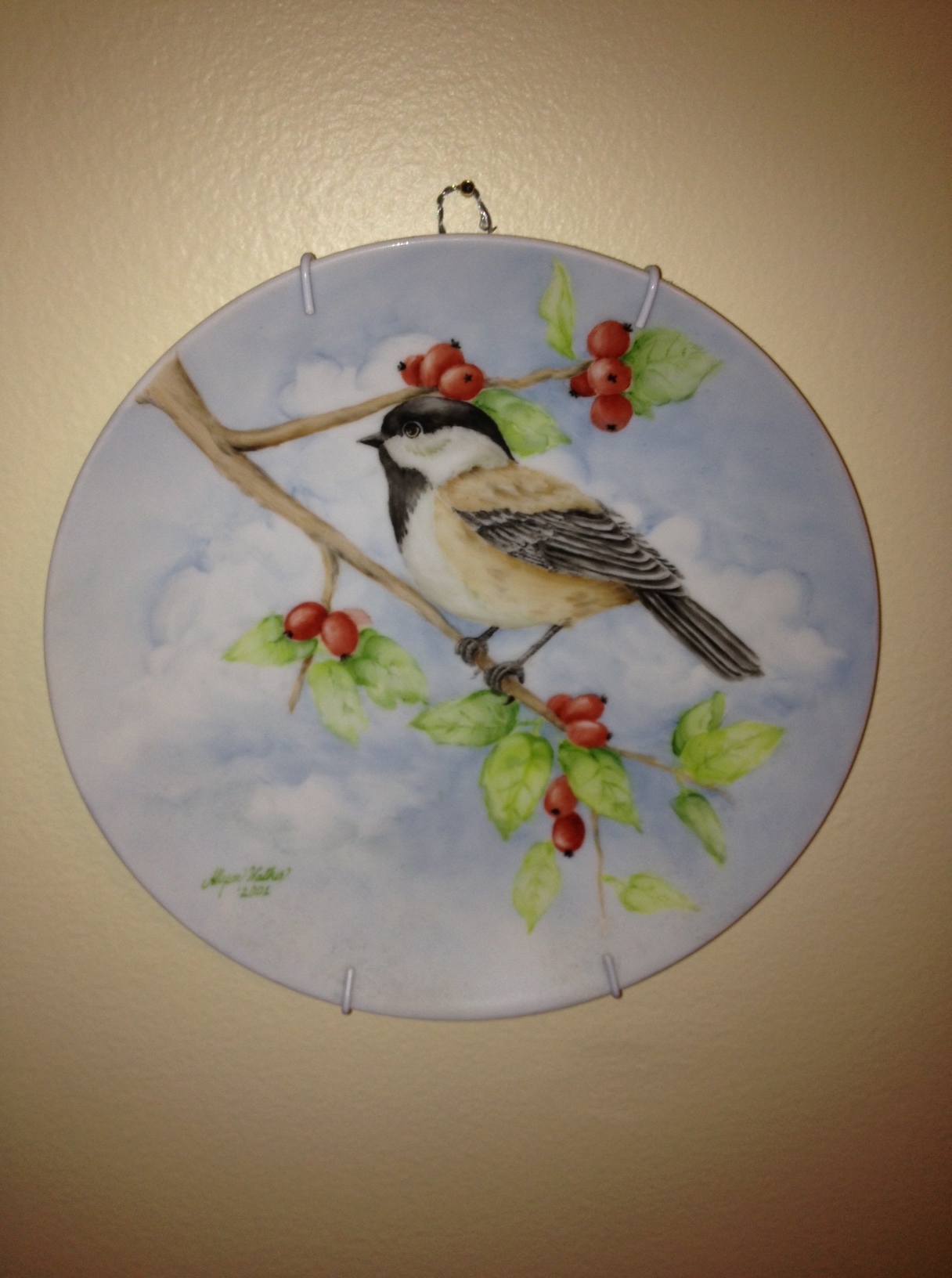
But she was just gifted in other ways.  She sang beautifully and she took up painting china.  Allyson had—and still has—a tender heart that is often conscious of needs the rest of the world overlooks. Allyson looks out for the “uncool” people. She meets needs that are truly needs.

In the next few years, Allyson went through a difficult heartbreak.  Some would think that would be the time that having sisters would come in quite handy.  But I’m not sure we were any help.  It wasn’t that I didn’t care—I just didn’t know what to say or do besides give her space.

So she really surprised me when she gave me two hand painted china plates.  They had birds on the fronphoto (1)t, and on the back of each, she had written scripture in her elegant script—“Behold the fowls of the air…” She must have spent many, many hours tediously painting those beautiful plates. At the bottom of one she had written, To my amazing sister, Danielle.

When the opportunity came for my family to move from California to New Hampshire, Allyson was the only dissenting vote.  But we went anyway.

And the day we moved in, we met Kevin.  Kevin met Allyson.  And as his grandmother said, “I’ve never seen a young man more in love.”

Shortly after their wedding, Allyson was expecting.  And she just glowed.  She is a beautiful girl anyway– but she was even more beautiful pregnant.  And we were all very, very happy for her.  She was a wonderful wife and I was sure she would be an equally good mother. Her child would be the first grandchild on both sides as well as the first great-grandchild for the two set of great-grandparents that lived locally.  Yeah, a little bit of pressure there.

A few months before the baby was due, she went in for a check-up and the doctors became concerned that the baby wasn’t responding to pokes and prods. I was at work when I heard there was a good chance she lost it, and I cried so hard I got in a wreck on my way home. But the doctors were wrong, and this little baby was born healthy as can be—even if he came a few weeks late.

It has been a steady stream of beautiful little lives since then: seven in the past ten years. And Allyson has handled it expertly. The nine of them live in a 1500 square foot house and she keeps it clean, orderly, and entirely devoid of junk. She still cooks food from scratch and washes her dishes by hand although I imagine she has said thanks more than once for their clothes washing machine. They have no TV, and she home schools the older three kids. Somehow.

By contrast, I feel like I’m doing good when I can see the corner of my desk. And people have started asking me what I’m going to do when I grow up.

But what is most amazing is not what Allyson does, but how she does it. She has the beauty that comes from a quiet contentment; an authoritative grace; a contagious peace.  And I can lay claim to being a part of the test panel for her rise to low-budget cooking genius.

I think college has its place in this world, but it isn’t for everyone and it probably would have had nothing but debt to offer someone like Allyson. If homemaking is an art, she has mastered it. And she did it by faithfully applying the lessons God teaches best in His way and in His time.

With the score 7 to 0, I think it’s safe to assume that I’ll never catch up. Thank goodness, it isn’t a competition anymore. Just two sisters who love each other even though they live a thousand miles a part. It’s hard to believe that we ever shared school books, a bedroom, and shoes.

Happy Mother’s Day, to my amazing sister, Allyson!

A Funny Thing Happened on the Way to the Courthouse

I have seen that title floating around for years. And I know now—more so than ever—that it is a lie. It’s a lie straight from—well—I can’t really imagine where because I don’t even know a lawyer that is a good enough liar to make that up. That’s like saying, “a funny thing happened during brain surgery.” Some things are just not funny.

The way to the courthouse is when you realize you forgot an exhibit you needed. It’s when you decide you need an exhibit you didn’t make. It’s when your client calls because they can’t find you and you realize they went to the wrong courthouse. It’s when someone in front of you gets in a wreck. It’s when the parking garage is full. It’s when you second guess whether you read the correct line of cases or are calling the right witnesses. It’s when the one hour of sleep you got the night before is just not enough.

You could put Barney Fife, Gomer Pyle, Mike Rowe and Yogi Berra in the car with you on the way to the courthouse and it would not be funny.

As a matter of fact, not much happens in the legal world that’s funny. That’s just the unfortunate fact of the field I’m in. Bizarre, yes. Contentious, yes. Funny, not much.

In the ten years I’ve worked at the BLF, we’ve had people forge insurance paperwork, intentionally break their own bones, name their two daughters the same thing, request a bronze pig as a headstone, falsify leases, claim severe scarring from bed bugs, and more. You should read what some people will fill in on a web form to describe their legal concerns. Yeah, there are some odd ducks out there. But save the one person who claimed they slipped out of the hotel shower into the toilet, not many are truly funny.

So when I decided that I wanted to write about something funny that happened at the Bostic Law Firm, I had to dig deep. Way deep. But one lady saved me.

I tried to change names to protect the innocent, but it just didn’t work. I couldn’t tell the story. So instead, I have changed names to protect the guilty. For the sake of this story, I will call her “Miss A” (only because it has pretty much nothing to do with her real name).

Miss A came to us because of a car wreck. She did not have a very good case, and frankly, it wasn’t long at all before we completely regretted having signed up Miss A.

But to her, it was the most important case in the world. And she called every day to make sure that it was being treated as such. I don’t know if she thought we were all hard of hearing or just stupid, but either way, she made sure we heard her by bellowing into the phone, “HI, THIS IS MISS A. IS PETER SAWYER THERE?”

It wasn’t a question, it was a demand, and frankly, it was entirely unnecessary. We knew who it was before she even got the “HI” out and no one would have robbed Peter of the pleasure of speaking with her that day.

If, for some reason, Peter was not able to satisfy her concerns over the phone, Miss A would unexpectedly show up and express herself in the lobby, “WHERE PETER SAWYER?” she would ask. The rest of us would run and hide. “I NEED PETER.” The glass doors would shake. Whatever Peter was doing, he would have no choice but to immediately direct his attention to her. “WHERE’S MY MONEY?” I would grab my wallet and sit on it.

Miss A was about twice Peter’s size (or so it seemed) and I was borderline scared for him a time or two. If things didn’t seem to be progressing as quickly as she would like, she let us know in decibels.

Fortunately, the day came for Miss A to come pick up her check. She arrived at the office decked to the hilt. Every nail painted; every eyelash in place—and about five times as long as natural. She wore platform shoes that made her presence even more noticeable (if that was possible), but she was sweet to our office manager; she was patient in the lobby. Peter was the conquering hero and the rest of us came out of hiding to witness the end of the historic era of Miss A.

After signing her release, and getting her check, Miss A, got up and floated out of the conference room.

This is the part I’m not sure I can do justice to. You may just have to have been there to really appreciate what happened next. You may just have to have known her. You may have to have heard her commanding voice booming through our office to really get the scene in your mind. But I’ll do my best.

Miss A was so happy, that she reached out to give Peter a crushing hug. Peter, who—to his credit—doesn’t generally go around hugging women, had no real choice about whether or not to participate. But from my view from the next room, I saw him try to extricate himself after ten seconds or so and it was a noble effort.

But Miss A’s long, flowing braids attached themselves to Peter’s glasses and her wig stayed even after he pulled away.

It was one of the funniest scenes of my life—Peter backing up and her voluminous wig preferring his glasses over her head.

It’s okay to laugh—it was not an “I’m battling cancer” wig it was more of an “I want to beautiful and I don’t have the patience” wig. And it was hilarious. I had to go back into hiding so I could laugh. And laugh I did.

That scene has provided me comic relief many, many times since.

Just not on the way to the courthouse.

Words

th4J3H24NS

I read his e-mail; and I was ticked.

First of all, he was wrong. What he was telling me was bogus and I knew it.

But it wasn’t so much what he said as how he said it that had me irritated. He had baited me for a fight and I was inches away from taking his bait.

I went back and re-read my prior e-mail to him. Looking at it subjectively, I had to admit that even though I hadn’t meant for it to sound ugly, someone who didn’t know that or know me might have understood it as ugly. So he had responded by taking things down a notch. And now, here I was, tempted to take us lower still.

There is a word for it. A five letter word that starts with a “P.” Proverbs tells us that only by pride comes contention. And in the legal world and in the real estate world, there is ton of it—both pride and contention—that is.

And sometimes, I get sucked right in. Like right now, when a realtor is trying giving me a legal lecture. I don’t need a realtor to tell me what the law is. That’s what I went to school for. What did he go to school for? Interior design? Auto repair? Landscaping? Tell me about those things.

When we are called on to “zealously” represent a client and to negotiate with other professionals, it is so easy to get caught in a battle where words become barbs and barbs become hooks that we use to drag others down.

I couldn’t count the number of days that have been ruined by a nasty exchange with another professional as we both try to do our jobs. I’ve been yelled at, I’ve been chewed up, I’ve been lectured, I’ve been educated, I’ve been blamed, I’ve been accused, and I’ve been just generally provoked.

And sometimes, I’ve fallen right in the trap. (I never create the trap, of course. Just fall in. Like the innocent victim of…well…of pride.)

Our egos, or rather, our pride doesn’t want the other side to get the final say. We want to win. Unfortunately, there is nothing to be won usually; just something to be lost—a relationship, a reputation, a testimony.

I have often regretted my words: what I said, and even more often, how I said them. In fact, the longer I work, the more I recognize the wisdom of kind words.

The problem with kinder, gentler, more peaceful responses is that they often require more humility than I have. I’m often not willing to be told I was wrong when, in fact, I could make a good case that I was right. I am often not willing to be told what I already know without saying, “I already knew that.” I’m often not willing to listen to someone else’s idea without saying, “I already thought of that.” I’m often not willing to take the blame that I believe belongs to someone else. Just writing these thoughts has brought back many things that came off my tongue that I could line up as “Exhibit A,” “Exhibit B,” and so on through the alphabet.

Mother Teresa is often quoted as instructing us to “speak kind words and receive kind echoes.” And she is right. If you live in a hollow tube. Personally, I would say that speaking kind words does not guarantee a kind response, although it greatly increases the chances.

Unfortunately, the chances are still good that sometimes, kind words will be greeted with an unkind response. Sometimes, my best effort at peacemaking will be misunderstood or just plain rejected.

And sometimes, I will still have to give orders, make offers, and tell truths that other people don’t want to hear. Sometimes I will have to ask people to do projects they don’t want to do; follow up with people who don’t want to be followed up with; change my plans and other peoples’ plans; and even reject their ideas. Sometimes I will be right and they won’t see it. And sometimes, I will be wrong and they will point it out.

So regardless of what I do and say, I will probably never win a popularity contest.

But I’m not trying to win a popularity contest.

I’m trying to please an Audience of One. I need to make sure the words of my mouth and the meditation of my heart will be acceptable in His sight.

Regardless of what the other guy does. Regardless of who understands what. Regardless of how the other side chooses to respond.

And that is why it requires humility. Because Mother Teresa is only partly right. Kind words won’t always get you what you want. Not even echoes of what you want. There is no selfish reason to be nice all the time.

So this is me reminding myself to choose kind words—not for the kind echoes—but for the One Listener who is more concerned that I learn Christ-like humility than whether I have a cute post, a funny tweet, or a winning argument. Then, no matter what, the echoes of my words will be true and right…and they will probably be kind.